face off
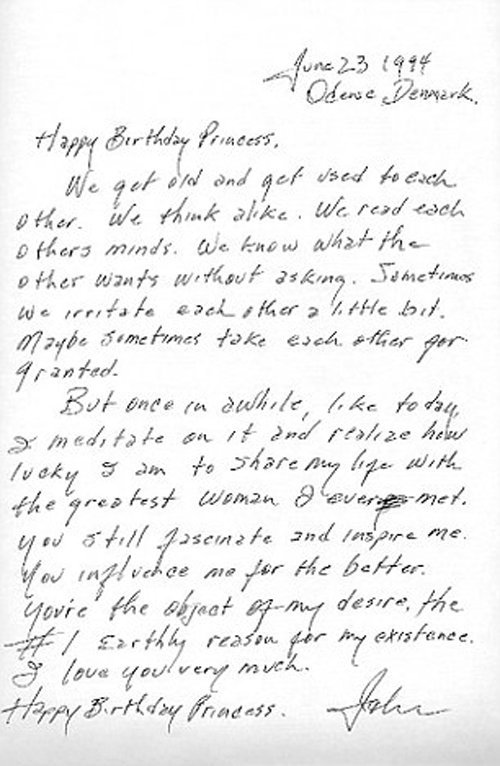
The letter reads:
Happy Birthday Princess,
We get old and get used to each other. We think alike. We read each other’s minds. We know what the other wants without asking. Sometimes we irritate each other a little bit. Maybe sometimes take each other for granted.
But once in awhile, like today, I meditate on it and realize how lucky I am to share my life with the greatest woman I ever met. You still fascinate and inspire me. You influence me for the better. You’re the object of my desire, the #1 earthly reason for my existence. I love you very much.
Happy birthday Princess. John
His opponent had short hair so Thompson shaved his head to call the other guy his “long-haired opponent”.via reddit.com
TIL Elvis once handed Alice Cooper one of his guns and asked him to point it at him to show off his karate skills. Cooper later said that he genuinely wanted to pull the trigger to do something legendary with his life, but Elvis knocked the gun out of his hand and pinned him before he could fire.
crouching tiger, hidden Elvis
“The Tucano are multilingual because men must marry outside their language group: no man may have a wife who speaks his language, which would be viewed as a kind of incest. Men choose women from various neighboring tribes who speak other languages. Furthermore, on marriage, women move into the men’s households or longhouses. Consequently, in any village several languages are used: the language of the men; the various languages spoken by women who originate from different neighboring tribes; and a widespread regional ‘trade’ language. Children are born into the multilingual environment: the child’s father speaks one language (considered the Tucano language), the child’s mother another, other women with whom the child has daily contact, and perhaps still others. However, everyone in the community is interested in language-learning so most people can speak most of the languages. Multilingualism is taken for granted, and moving from one language to another in the course of a single conversation is very common”
aloneandforsakenbyfateandbyman:
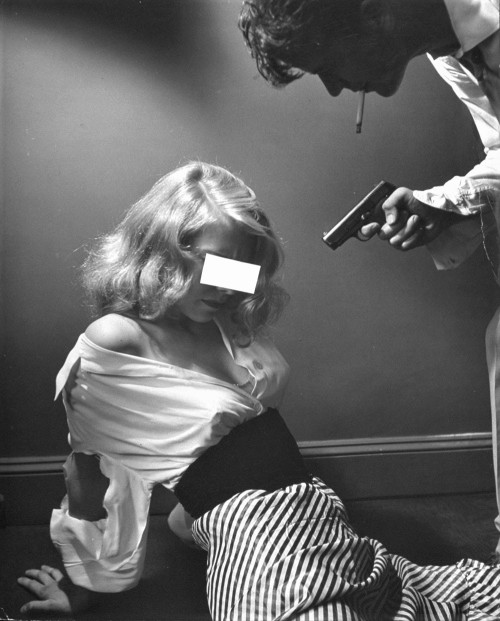
A Ford Modeling Agency girl poses in a crime illustration advertisement, which was later banned for being “too undignified.” Shot by Nina Leen, 1948.
via reddit.com

Nam June Paik
„Video-Synthesizer“, 1969/92.
Installation, 210 (305 with monitors) x 155 x 150 cm,
Original incl. synthesizer, two moving frames, 12 monitors of different sizes, 2 DVD players, @ Kunsthalle Bremen - The Kunstverein in Bremen,
© Nam June Paik Estate, New York, 2010.
Photo by Jürgen Nogai

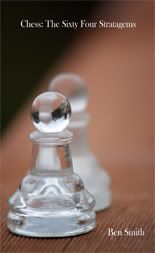
My horrible typos and silly word slinging has been painstakingly edited by my good friend and fellow writer for HST, Ian Shearer; with special thanks to Mike Daily for being such a dude. This is not the collection of artists featured in HST over the past few months, this is a book i started long before the HST was even thought about.
108 pages; 6" x 9", jacket-hardcover binding, cream interior paper (50# weight), black and white interior ink, white exterior paper (100# weight), full-color exterior ink. Jacket Wrap and gold embossing on cloth spine.
While i have tried to keep the price as absolutely low as possible (I'm making about 1 dollar from each book) i know it's still scrapped in a little steep but with out pissing in my pocket - it really is worth the money spent, not only for my poetry but for the entire feel and complete package only a hard cover like this can embody.Obviously for adults only, i am very pleased to send this sucker out into the world and hope for a wide reception of feedback in any form, from any one! Please DO NOT buy this book if you are easily offended, have any shred of respect for me at all, don't want to hear stories about my penis, fear you may be exposed in one of these poems, are a family member of mine of D'Arnes,if you drink soy latte's or enjoy poetry about flowers and rivers. Any one else, please check it out with a grain of salt and a giggle and i thank you in advance for your support and on going communication.
Lets all get pissed and say silly things!


Double Penetration is Horror Sleaze And Trash's first publication; featuring the poetry of Ryan Quinn Flanagan and Ben Smith. A collection of 70 off-beat and low brow poems you imagine the pair to come up with in this mix of madness. 10 Aussie bucks will get this sucker to your door. A5 in size, about 80 pages, soft card cover with black and white insides. Buy it now, or don't, and wish you hadda, 25 limited copies. Great gift idea for your Grandmothers!
 "Drunk at the matinee" is a collection of candid poetry about stupid shit that we all experience from day to day.
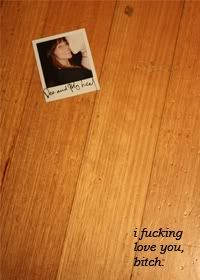 "I fucking love you, Bitch" is my new
card cover chap book, 25 pages, color cover
and b/w insides. Poetry based on the duality
of the sexes - but mainly filth and stories
that made my girl laugh.
"I fucking love you, Bitch" is my new
card cover chap book, 25 pages, color cover
and b/w insides. Poetry based on the duality
of the sexes - but mainly filth and stories
that made my girl laugh.


Date: 2009
Details: Gluebook, 21 x 25,5 x 2 cm, mixed media (adhesive tape, spray paint, oil/color sticks, acrylic, paper, color and black&white prints on kid’s book), 24 pages, handmade, signed, unique piece
Art work by {THS} http://www.ths.nu/
With poems by Ben John Smith, Australia.